Lecture 16
Filter Design in CT
2026-03-05
Ideal Filters and Paley-Wiener Conditions
Recall from ECE 2714 the four basic frequency selective filters:
low-pass
high-pass
band-pass
band-stop / band-reject / notch
Recall also that the ideal versions of these are non-realizable because they are non-causal and violate the Paley-Wiener conditions. These conditions state that a causal filter:
can have \(H(\omega) = 0\) at only a finite number of frequencies
cannot have \(H(\omega) = 0\) over any finite range of frequencies
transition from pass-band to stop-band and vise-versa cannot be zero width
cannot specify \(\|H(\omega)\|\) and \(\angle H(\omega)\) independently
For example, the ideal low-pass filter has a frequency response
\[H(\omega) = \left\{ \begin{array}{cc} 1 & |\omega| < \omega_c\\ 0 & \text{else} \end{array} \right.\]
and clearly violates the first three conditions.
The inverse Fourier transform of the frequency response is the impulse response, in this case the sinc function
\[h(t) = \mathcal{F}^{-1}\left\{H(j\omega)\right\} = \frac{1}{\pi t}\sin(\omega_c t)\]
Since the impulse response it not a causal signal, the system is not causal and thus not physically realizable.
Practical Filters
Realizable filters must relax the strict conditions imposed by ideal filters. Practical filters are thus specified by one or more pass-bands, transition-bands, and stop-bands.
Low-Pass Specification
Consider a generic low-pass frequency response magnitude,
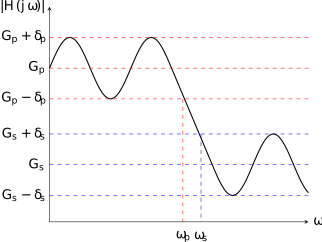
where:
\(G_p\) is the pass-band gain (often unity);
\(\delta_p\) is the pass-band ripple;
\(\omega_p\) is the pass-band edge frequency, also known as the filter bandwidth or cut-off frequency \(\omega_c\);
\(G_s\) is the stop-band gain;
\(\delta_s\) is the stop-band ripple;
\(\omega_s\) is the stop-band edge frequency;
and \(\omega_s - \omega_p\) is the transition bandwidth.
Generally, \(G_p\), \(\delta_p\), \(G_s\), and \(\delta_s\) are specified in dB or V/V, and the edge frequencies, \(\omega_p\) and \(\omega_s\), in rad/s or Hz.
Band-Pass Specification
The band-pass has two stop-bands (lower and upper), two transition bands (lower and upper); and a pass-band defined by a center frequency \(\omega_0\) and bandwidth, or two pass-band edge frequencies (lower and upper). Consider a generic band-pass frequency response magnitude,
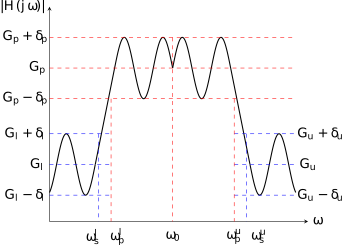
where:
\(G_p\) is the pass-band gain (often unity);
\(\delta_p\) is the pass-band ripple;
\(\omega_p^l, \omega_p^u\) are the lower and upper pass-band edge frequencies;
\(G_l, G_u\) are the lower and upper stop-band gains, often the same;
\(\delta_l,\delta_u\) are the lower and upper stop-band ripple;
\(\omega_s^l, \omega_s^u\) are the lower and upper stop-band edge frequencies;
\(\omega_s^u - \omega_p^u\) and \(\omega_p^l - \omega_s^l\) are the upper and lower transition bandwidths;
\(\omega_p^u- \omega_p^l\) is the filter bandwidth;
and \(\omega_0\) is the center frequency.
As with the low-pass filter specification, the gains and ripples are specified in dB or V/V, and the edge frequencies in rad/s or Hz.
Filter Design
We can focus on design of just low-pass filters since we can transform a low-pass frequency response into the others as described below. The design problem then is to find a transfer function \(H(s)\) that is stable and has a corresponding frequency response, \(H(\omega)\), approximately that desired. The most popular approach is to use particular parametric forms for the magnitude of the frequency response. We then find the transfer function by imposing symmetry and stability conditions that make the filter stable and have a real-valued impulse response.
Most filter design procedures allow for meeting a particular constraint on a filter parameter, while giving a best-effort on others. In general the tighter the parameters (e.g smaller transition bandwidths) the higher the order of the system required to implement that filter.
Butterworth Filters
Butterworth filters have a power spectrum of the form
\[\left|H(\omega)\right|^2 = \frac{1}{1 + \left(\frac{\omega}{\omega_c}\right)^{2N}}\]
for an order \(N\) system. They are maximally flat and are well approximated by a piece-wise linear \(H(s)\) (see lecture 14).
To find the corresponding transfer function we note
\[\left|H(\omega)\right|^2 = H(\omega)H^*(\omega)\] Since we desired a real-valued impulse response we impose conjugate symmetry, i.e. \(H^*(\omega) = H(-\omega)\). Thus
\[\left|H(\omega)\right|^2 = H(\omega)H^*(\omega) = H(\omega)H(-\omega) = \left. H(s)H(-s) \right|_{s = j\omega}\]
Then
\[H(s)H(-s) = \frac{1}{1 + \left(\frac{-s^2}{\omega_c^2}\right)^{N}}\]
When \(N\) is odd
\[\left(\frac{-s^2}{\omega_c^2}\right)^{N} = \frac{-s^{2N}}{\omega_c^{2N}}\] and
\[H(s)H(-s) = \frac{-\omega_C^{2N}}{s^{2N} - \omega_C^{2N}}\]
The poles are the roots of \(s^{2N} - \omega_C^{2N} = 0\) or
\[s^{2N} = \omega_C^{2N} = \omega_C^{2N} e^{j2\pi k} \quad\text{for} k = 0,1,2,\ldots,2N-1\] Thus we see that the poles are at \(p_k = \omega_c e^{j\pi \frac{k}{N}}\).
By a similar argument when \(N\) is even \(p_k = \omega_c e^{j\pi \frac{2k+1}{2N}}\) for \(k = 0,1,2,\ldots,2N-1\). This allows us to write the transfer function as
\[H(s) = \frac{\omega_C^N}{\prod\limits_{k} (s-p_k)} \quad\text{for}\quad \frac{\pi}{2} < \frac{k\pi}{N} < \frac{3\pi}{2}\]
where the condition on \(k\) is to ensure the poles are in the left-hand side of the complex plane, and thus correspond to a stable system.
To help visualize this we can plot the poles of both \(H(s)\) and \(H(-s)\).
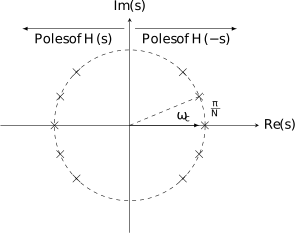
If \(H(s)\) has a pole \(p_i = \alpha_i + j\omega_i\) then \(H(-s)\) has a pole at \(-p_i = -\alpha_i - j\omega_i\), the mirror image.
This configuration is sometimes called a "wall" of poles at radius \(\omega_c\). The order of the system, or equivalently the number of poles in the wall, \(N\), must be chosen to meet the specifications.
We will skip the derivation but just give an expression in terms of the filter specification. Let \(A = G_p - \delta_p\) and \(B=G_s\) be specified in dB, then to meet the specifications the filter order must be the smallest integer \(N\) such that
\[N \geq \frac{\log_{10}\left[ \frac{10^{-B/10}-1}{10^{-A/10}-1} \right]^{\frac{1}{2}}}{\log_{10}\left( \frac{\omega_s}{\omega_p}\right)}\]
For example, suppose \(G_p = 0\) dB, \(\delta_p = 3\) dB, \(G_s = -40\) dB, and \(\omega_p = 2\pi\cdot 5000\), \(\omega_s = 2\pi\cdot 20 000\).
\[\left[ \frac{10^{40/10}-1}{10^{3/10}-1} \right]^{\frac{1}{2}} \approx 100.2327\] then
\[N \geq \frac{\log_{10}(100.2327)}{\log_{10}\left( \frac{20000}{5000}\right)} = 3.323\] thus \(N = 4\) is required to meet the specification.
In Matlab/Octave (and Python spy.signal library) the
butterd function will give the order required to meet a
given specification while the butter function will give the
corresponding filter coefficients of the numerator and denominator
polynomials, or equivalently the gain, zeros, and poles.
Chebyshev Filters
Type I Chebyshev filters have a power spectrum of the form
\[\left| H(\omega) \right|^2 = \frac{1}{1 + \epsilon^2C_N^2\left( \frac{\omega}{\omega_p}\right)}\] where \(\epsilon > 0\) and \(C_N(v)\) is the Chebyshev polynomial of order \(N\)
\[C_N(v) = \cos\left(N\cos^{-1}(v)\right)\]
This polynomial is defined recursively with
\[C_{N+1}(v) = 2vC_N(v) - C_{N-1}(v)\] where the base case of the recursion is \(C_0(v) = 1\), \(C_1(v) = v\). Thus
\[\begin{align*} C_2(v) &= 2v C_1(v) - C_0(v) = 2v^2 - 1\\ C_3(v) &= 2v C_2(v) - C_1(v) = 4v^3 - 3v\\ \vdots &= \vdots = \vdots \end{align*}\]
The design procedure is then given \(\epsilon\), \(N\), \(\omega_p\)
Find \(C_N(v)\)
Substitute \(v = \frac{\omega}{\omega_p}\)
Find the poles of \(H(s)\) equivalent to \(|H(\omega)|\).
Step 3 is similar to the Butterworth example
\[\left| H(\omega) \right|^2 = \left. H(s)H(-s) \right|_{s=j\omega} = \frac{1}{1 + \epsilon^2C_N^2\left( \frac{s}{j\omega_p}\right)}\]
The poles of \(H(s)H(-s)\) are solution to \(1 + \epsilon^2C_N^2\left( \frac{s}{j\omega_p}\right) = 0\) for \(k = 0,1,\ldots, 2N-1\). Skipping the derivation
\[p_k = j\omega_p \left[\cos(\alpha_k)\cosh(\beta_k) - j\sin(\alpha_k)\sinh(\beta_k) \right]\] where
\[\alpha_k = \frac{\pi(2k+1)}{2N} \qquad \beta_k = \frac{\sinh^{-1}(1/\epsilon)}{N}\]
It remains to find \(N\) and \(\epsilon\) that meet a desired specification. Again skipping the derivation, let \(A = G_p - \delta_p\) and \(B = G_s\).
\[\epsilon = \left[10^{-A/10} - 1\right]^{\frac{1}{2}} \qquad N \geq \frac{\cosh^{-1}(F)}{\cosh^{-1}(\omega_0)}\] where \[F = \left[ \frac{10^{-B/10} - 1}{10^{-A/10} - 1} \right]^{\frac{1}{2}} \qquad\text{and}\qquad \omega_0 = \frac{\omega_s}{\omega_p}\]
In Matlab/Octave (and Python scipy.signal library) the
cheb1ord function will give the order required to meet a
given specification while the cheby1 function will give the
corresponding filter coefficients of the numerator and denominator
polynomials, or equivalently the gain, zeros, and poles.
Filter Transformations
Let \(G(s)\) be the transfer function resulting from a low-pass design. Define
\[H(\lambda) = \left. G(s) \right|_{s = f(\lambda)}\] for \(s,\lambda\in\mathbb{C}\) and filter transformation function \(f:\mathbb{C} \rightarrow \mathbb{C}\).
low-pass to high-pass
Define
\(\omega_{LP}\) as low-pass pass-band edge
\(\omega_{HP}\) as high-pass pass-band edge
then
\[f(\lambda) = \frac{\omega_{LP}\cdot \omega_{HP}}{\lambda}\]
low-pass to band-pass
Define
\(\omega_{LP}\) as low-pass pass-band edge
\(\omega_{BR}\) as band-pass left pass-band edge
\(\omega_{BL}\) as band-pass right pass-band edge
then
\[f(\lambda) = \frac{\lambda^2 + \omega_0^2}{B\lambda}\]
where \(\omega_0 = \left[ \omega_{BR}\cdot\omega_{BL}\right]^{\frac{1}{2}}\) and \(B=\frac{\omega_{BR}-\omega_{BL}}{\omega_{LP}}\).
Software Filter Design Examples
Below are some examples that demonstrate how to use software tools to
design CT filters. These examples use the python
scipy.signal library but this can also be done essentially
the same way using Matlab.
Low-Pass Butterworth
Suppose the goal is to design the same low-pass filter with specifications:
The pass-band gain is \(G_p = 0\) dB.
The pass-band ripple is \(\delta_p = 3\) dB.
The pass-band edge is 8 kHz.
The stop-band gain is -20 dB.
The stop-band edge is 10 kHz.
We start by importing the required Python libraries
import scipy.signal as signal
import matplotlib.pyplot as plt
import numpy as np
We then create variables holding the filter specification:
# --- Filter Specifications ---
rp = 3             # pass-band ripple (dB)
gpass = rp         # pass-band gain + ripple (dB)
wp = 2*np.pi*8000  # cut-off frequency (pass-band edge)
gstop = 20         # negative of stop-band gain (dB)
ws = 2*np.pi*10000 # stop-band edge
Then we call the functions to determine the required filter order and the corresponding numerator and denominator coefficients of the transfer function:
# --- Design the Filter ---
# Filter order required and corresponding pass-band edge
N, wn = signal.buttord(wp, ws, gpass, gstop, analog=True)
# Numerator and denominator coefficients
b, a = signal.butter(N, wn, btype='low', analog=True, output='ba')
The result is an 11th order filter with magnitude frequency response:
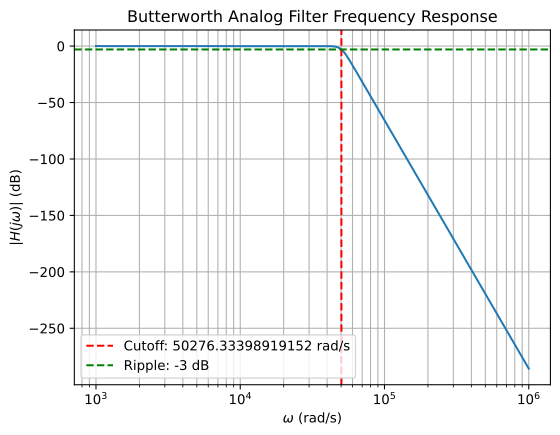
Note the pass-band is flat and the response meets the specifications, but the system order of 11 is pretty large and impractical for a CT filter, requiring six filter stages.
Low-Pass Chebyshev
Suppose the goal is to design the same low-pass filter as in the Butterworth example above. Given the same setup as before, we call the functions to determine the required filter order and the corresponding numerator and denominator coefficients of the transfer function:
# --- Design the Filter ---
# Filter order required and corresponding pass-band edge
N, wn = signal.cheb1ord(wp, ws, gpass, gstop, analog=True)
# Numerator and denominator coefficients
b, a = signal.cheby1(N, rp, wn, btype='low', analog=True, output='ba')
The result is a 5th order filter with magnitude frequency response:
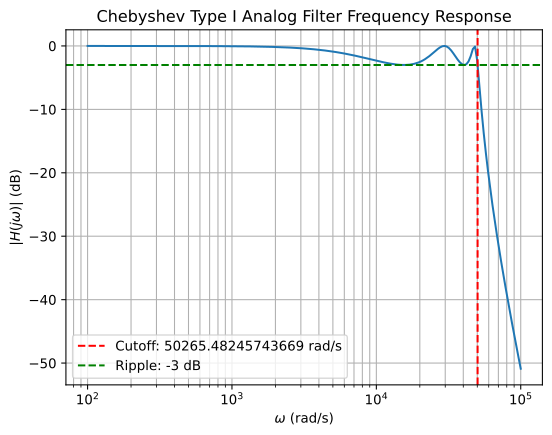
Note the required filter order is much smaller (5 vs 11) but the cost is more gain variation in the pass-band, although it meets the specifications given. This filter would be much more practical to implement requiring just three stages.